On a Friday night in September, the parking lot at Twice A Town Taproom on East Main Street fills with trucks that didn't come from Salem. Look at the tags, the boat hitches, the fishing rod holders bolted to truck beds, and you start to notice they're carrying people from Keowee Key, Keowee Harbour, Keowee Bay, White Water Lake, and even Tamassee and Walhalla, towns that have their own bars if they wanted to stay home. They didn't stay home. They drove to a two-block stretch of Highway 11 in a town of a few hundred people, because that stretch is doing a job no single gated community can do for itself.
That's the thing about Salem most people miss when they think of it as just "the lake town." It isn't one neighborhood. It's a scatter of private, amenity-rich developments strung along the Keowee and Jocassee shoreline, each with its own docks and clubhouse, and none of them with a public square. Main Street Salem is the square they share.
Why one taproom serves a dozen communities
Twice A Town Taproom shows up on Nextdoor as a neighborhood favorite in more places than Salem proper. Users from Keowee Harbour, Keowee Bay, White Water Lake, Keowee Key, and Salem itself list it as their spot, and the same is true for residents as far out as Tamassee and Walhalla. That's not a coincidence of good marketing. It's what happens when a region's housing stock is organized around private lake access rather than a traditional downtown grid.
Most lake communities in the Southeast solve this problem with a marina restaurant or a clubhouse that's technically open to the public. Salem solves it with a trivia night, a cornhole setup, and 75-cent wings. The taproom's draw isn't its size. It's that it's one of the only rooms in a twenty-minute radius where residents of a dozen separate developments end up standing next to each other without a membership card.
If you live here, you already know the rhythm. Tuesday through Wednesday it's quiet, the taproom running short hours for regulars. By Thursday the food trucks start rotating through, and Friday and Saturday nights the crowd doesn't clear out until close to 9:30. That's not a schedule built for tourists passing through on their way to Devils Fork. It's a schedule built for people who live within twenty minutes and treat the place like a living room.
The other Salem, facing the water
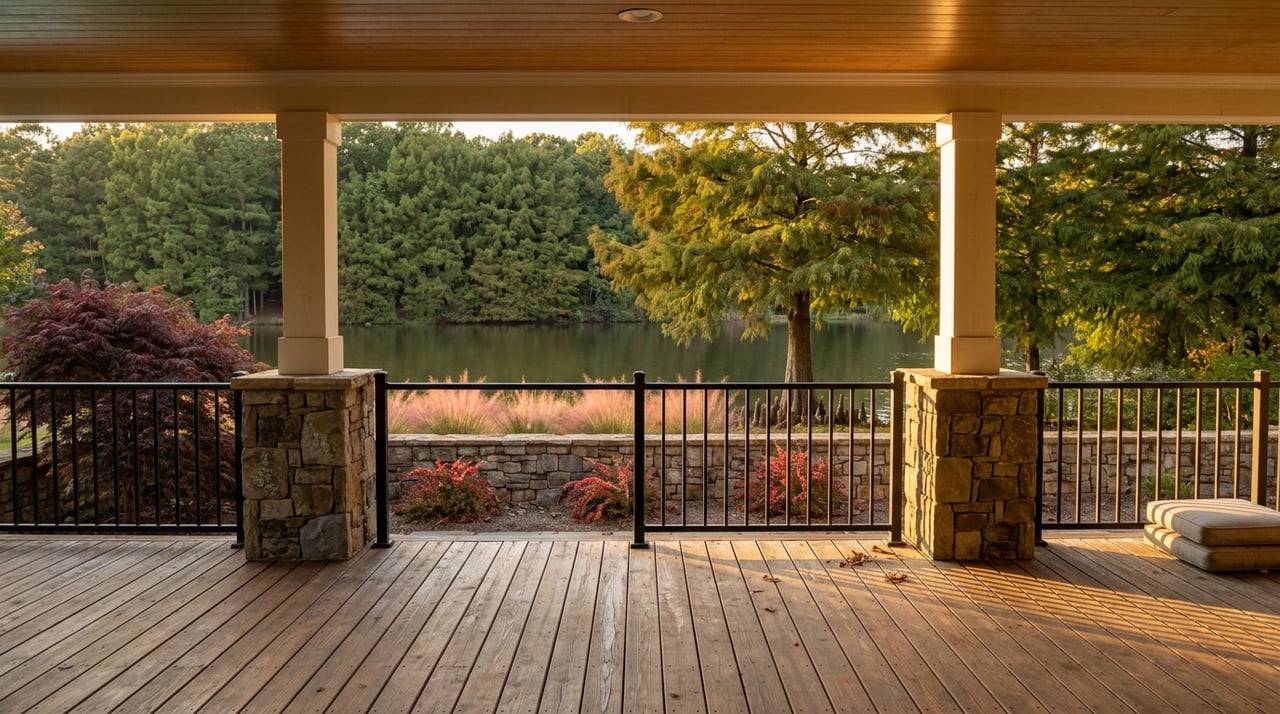
Flip the orientation ninety degrees and there's a second Salem entirely, the one that faces Lake Keowee instead of the highway. The Lighthouse restaurant sits directly across from The Cabana Sip & Swing, an outdoor casual spot with its own view of the water, and the two function almost like a matched pair, one for a sit-down dinner after a day on the boat, the other for a drink you can carry down toward the shoreline. This is the after-boat crowd, distinct from the after-work crowd that fills the taproom on a Wednesday.
The split matters if you're trying to understand how Salem actually spends a Saturday. The water-facing businesses run on boat traffic and daylight. The Main Street businesses run on evening gatherings once the boats are back on the trailer. Very few towns this small support two separate social ecosystems that rarely overlap, and it's a direct consequence of how spread out the actual housing is. There's no single main drag where both crowds would naturally collide.
What the June fire exposed about shared infrastructure
Every lake community depends on unglamorous shared infrastructure that nobody thinks about until it's gone. Boat storage is one of those pieces. On June 18, 2026, a fire tore through Fall Creek Boat Storage near the Oconee and Pickens county line, just outside Salem. Multiple buildings were declared a total loss, and county officials estimated 40 to 60 boats were damaged in the blaze. Six local fire departments responded, and a firefighter was treated for injuries during the response.
What made the story stick around the dock all summer wasn't just the size of the loss. It's that boat storage is one of the few pieces of lake infrastructure that isn't private and isn't duplicated inside every gated community. Keowee Key has its own marina. White Water Lake has its own access. But dry storage for boats that don't live on a private dock has always run through a handful of independent operators like Fall Creek, and when one of them goes down, there's no gated-community equivalent to absorb the overflow. It's the same logic as the taproom, just applied to boats instead of barstools. Salem's shared spaces are small, few, and heavily used, which means a single fire or a single closed bar has a bigger ripple than it would in a town with more redundancy built in.
The fall calendar, on the water and off
None of this means Salem's social life is fragile. It means it's concentrated, and concentrated things are easy to plan around once you know where they sit.
Late summer and early fall bring the parts of the calendar that don't depend on any single business staying open. Lake Keowee has hosted competitive bass tournaments like the Phoenix Bass Fishing League stop this past spring, the kind of event that brings out-of-area anglers into the same coves the weekend regulars already know by name. Keowee Key has hosted its Honoring Their Service veterans event for fifteen years running, a fixture on the community calendar that's outlasted plenty of businesses that have opened and closed along Highway 11 in that same span. And for anyone who wants a day away from the water without leaving the area, Devils Fork State Park and Lake Jocassee sit close enough to make it a half-day trip rather than a full one, the kind of side excursion locals treat as a reset rather than a destination.
Jocassee Valley Brewing Company fits into this same rhythm, though it runs on its own schedule. Live music and food trucks show up Friday and Saturday, with the outdoor stage and fireplace drawing a crowd that skews toward families and dog owners rather than the later trivia-night crowd across town. It's not competing with the taproom so much as filling a different slot in the same week, one more room in a small collection of rooms that a spread-out lake population keeps returning to because there simply aren't many others.
What this adds up to
Salem doesn't function like a normal small town, and it isn't trying to. It's a handful of private, self-contained lake communities that share almost nothing in common except a short public stretch of Highway 11 and a handful of water-facing businesses across town. That scarcity is exactly what gives the taproom, the brewery, and the two lake restaurants their outsized pull. It's also why a single fire at a boat storage yard becomes a season-long topic of conversation instead of a one-week news story. When your shared spaces are this few, everyone feels it when one of them changes.
If you're already living this rhythm, you don't need a guide to Salem. But if you're weighing what it would mean to put down roots on this stretch of the lake, or you're trying to figure out which side of that Main Street and water-facing split fits how you actually want to spend a Saturday, that's a conversation worth having with someone who tracks this market block by block. Southern Real Estate and Development works this part of the Upstate every week, from the Salem shoreline to the towns feeding into it, and can walk you through what a specific property actually means for the kind of weekend you're trying to build. Reach out for a consultation or start with an instant home valuation if you're weighing your own next move on the lake.